Archive | Quotes RSS feed for this archive
Quote

William James on “Habit”

“Habit is thus the enormous fly-wheel of society, its most precious conservative agent. It alone is what keeps us all within the bounds of ordinance, and saves the children of fortune from the envious uprisings of the poor. It alone prevents the hardest and most repulsive walks of life from being deserted by those brought up to tread therein. It keeps the fisherman and the deck-hand at sea through the winter; it holds the miner in his darkness, and nails the countryman to his log-cabin and his lonely farm through all the months of snow; it protects us from invasion by the natives of the desert and the frozen zone. It dooms us all to fight out the battle of life upon the lines of our nurture or our early choice, and to make the best of a pursuit that disagrees, because there is no other for which we are fitted, and it is too late to begin again. It keeps different social strata from mixing. Already at the age of twenty-five you see the professional mannerism settling down on the young commercial traveller, on the young doctor, on the young minister, on the young counsellor-at-law. You see the little lines of cleavage running through the character, the tricks of thought, the prejudices, the ways of the ‘shop,’ in a word, from which the man can by-and-by no more escape than his coat-sleeve can suddenly fall into a new set of folds. On the whole, it is best he should not escape. It is well for the world that in most of us, by the age of thirty, the character has set like plaster, and will never soften again.”

William James

The More I Remember, the More I Remember

Over the past year or so of writing true stories I have reached the conclusion that we are in fact bottomless wells of stories. Even if we think we don’t remember much, we actually do have a surprising amount stored away. The more I remember, the more I remember. I also have had a growing awareness of the relationship between strong emotions and vivid memories. If you can recall something that happened to you when you were five, chances are very good that you were feeling something significant at the time. And what that means is that sometimes there’s a story to be found there too.

Read More

John Steinbeck on Story Tellers

And it came about in the camps along the roads, on the ditch banks beside the streams, under the sycamores, that the story teller grew into being, so that the people gathered in the low firelight to hear the gifted ones.

Read More

Billy Bob Thornton on having a singular vision

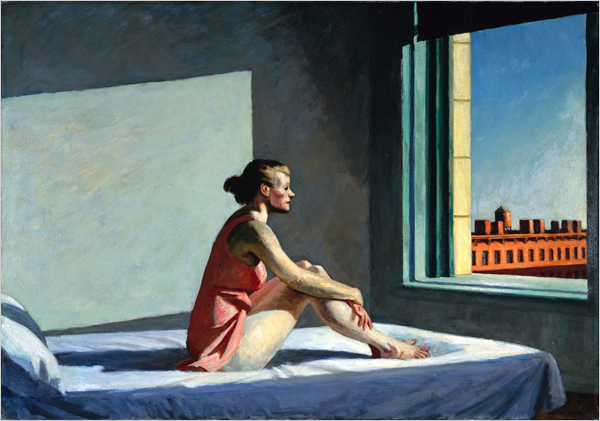
hopper

Edward Hopper…is the writer and actor, and he shows his painting to Bud and Carl, the producer and the director. They say, “Yeaahhhh, Edward, it’s nice, real nice, I like that, it’s kinda moody. We’re just afraid that it’s kinda lonely for what we’re going for here.” And Edward Hopper responds, “Well, that’s the point. The goddamn painting is called ‘Loneliness.’”

Read More

Tim O’Brien on storytelling

“The thing about a story is that you dream it as you tell it, hoping that others might then dream along with you, and in this way memory and imagination and language combine to make spirits in the head.” – Tim O’Brien, “The Things They Carried”

Read More

Charlie Kaufman: “What I have to offer”

The mind behind Being John Malkovich, Human Nature, Adaptation, Eternal Sunshine of the Spotless Mind and Synecdoche, New York talks, well, not so much about screenwriting but more about writing, authenticity and vulnerability. The video below presents highlights, but you can easily follow links to the entire lecture in audio or transcript form. What I […]

Read More

Paul Ricoeur on What a Story Is

A story describes a sequence of actions and experiences done or undergone by a certain number of people, whether real or imaginary. These people are presented either in situations that change or as reacting to such change. In turn, these changes reveal hidden aspects of the situation and the people involved, and engender a new […]

Read More

Theodor Adorno on Writing

“Properly written texts are like spiders’ webs: tight, concentric, transparent, well-spun and firm. They draw into themselves all the creatures of the air. Metaphors flitting hastily through them become their nourishing prey. Subject matter comes winging toward them.”

Read More
Follow

Get every new post delivered to your Inbox.